From the editor
I just returned from attending the Australia New Zealand College of Veterinary Scientists (ANZCVS) Vet Science Week 2026 Conference held on the Gold Coast of Australia. It was a great conference with some dynamic speakers, and I had the opportunity to present some of our most recent findings associated with the long-term impacts of disease on dairies.
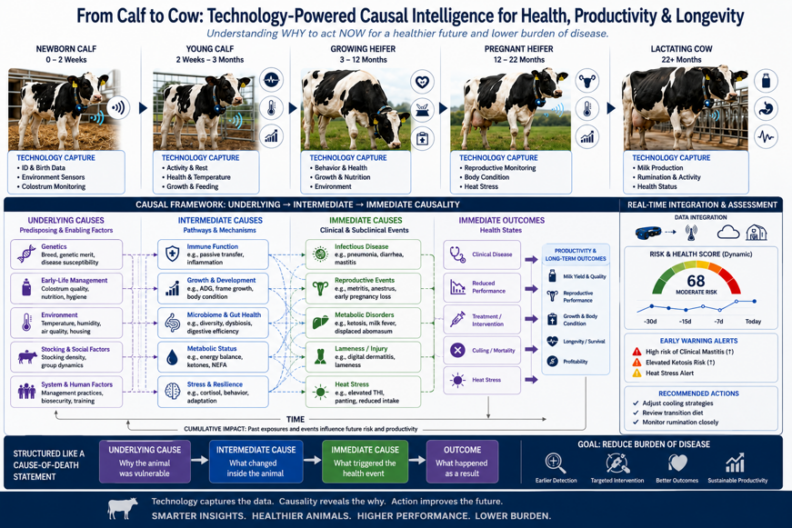
Lindsey Makratzakis has been the point person evaluating our findings from this project as she wraps up her PhD, and one of the key takeaways from her work has been the need for precision sensor data from birth through productive life that can provide insight into underlying, intermediate and immediate causality influencing health issues across time. Current records and diagnostic options often fail to capture health impacts wholistically, but if an animal were to grow up with technological monitoring, we should be able to refine and improve our oversight around case definitions, therapeutic interventions, and overall management. I think that the Figure at the end of this section does a nice job of capturing this concept, and provides a solid perspective on the types of causal factors we should consider integrating as we work to improve the productive life of our animals.
This area of consideration aligns with some recent work that was highlighted at the recent American Dairy Science Association Annual Meeting held in Milwaukee, Wisconsin. Lindsey was able to attend the meeting and summarized a couple of pertinent abstracts below.
Abstract 169: Temporal dynamics of culling reasons in American dairy herds.
L. Henrique da Silva*, Y. Gong, and V. E. Cabrera, University of Wisconsin–Madison, Madison, WI.
Occasionally it is valuable to pause and assess where the industry stands and evaluate if current trends align with the trajectory we want. A ten-year review of U.S culling patterns was presented using 6,729,954 records from the Council of Dairy Cattle Breeding (2006 – 2017). The most common removal reasons reported (to no-one’s surprise) were “feet and legs”, dairy, low production, reproductive, “other or injury”, mastitis, and death.
Across the evaluation period, culling due to mastitis, reproduction, and feet and legs remained relatively stable. Meanwhile, removal by death declined (~ 19% to 14%) and removal for low production nearly doubled (~8% to 16%). These shifts suggest both a reduction in on-farm mortality and stronger managerial emphasis on production-based culling. Despite improvements in mortality, the persistent ~25% of removals attributed to “other or injury” as well as “dairy” raises important questions. Who are these cows, and what are the underlying issues driving their departure? Broad labels such as “other” and “dairy” lack the specificity needed to inform management strategies or deepen our understanding of herd level population dynamics.
Abstract 216: Double the trouble: Improving disease resilience, wellbeing, and productivity in peripartum dairy cows and newborn calves.
S. Mann*, Cornell University, Ithaca, NY.
Dr. Sabine Mann shared a synthesis of her career-long work on improving disease resiliency, wellbeing, and productivity in our periparturient “transition” dairy cows and their calves. Central to her perspective is the idea that the transition cow and her newborn calf should be viewed as an interconnected pair rather than independent management units. Maternal nutrition, physiology, and management decisions (e.g., dry period, cow-calf separation) ultimately shape colostrum quality and neonatal immune development, creating a shared health trajectory.
Her emphasis aligns closely with our lab’s molecular work examining how early life calfhood disease influences downstream transition cow health. In our investigation of chronic calfhood lung consolidation, we found that healthy transition cows with previous history of calfhood lung consolidation exhibited metabolic dysfunction alongside an impaired innate immune response, as compared to healthy transition cows that remained healthy during calfhood. These findings suggest that despite appearing clinically healthy, transition cows with previous calfhood disease have a molecular signature indicating increased susceptibility to disease and inflammation later in life, even when overt clinical symptoms may be absent.
From a practical standpoint, these findings highlight the value of identifying cows with prior chronic calfhood disease and providing enhanced health oversight during the periparturient period. Early detection and timely intervention for fresh cow diseases (e.g., metritis, ketosis, mastitis) may help mitigate long term impacts (e.g., reduced milk production, impaired fertility) of early life disease and support more resilient transition cows. Ultimately, our insight into herd health is only as strong as the accuracy and detail of our records. The growing access to precision agriculture technology offers new opportunities for monitoring animal health and informing strategic management decisions, and I’m looking forward to see where the next few years lead!
– Craig
Stories in this issue
- Beyond Shade: Could agrivoltaics improve heat abatement in western U.S. dairy systems? Heat stress remains one of the most significant environmental challenges affecting dairy production. One emerging approach attracting attention is agrivoltaics, which is the integration of solar photovoltaic panels into agricultural production systems.
- Omphalitis in dairy calves an under-recognized disease with lasting consequences The umbilical cord may only be present for a few days after birth, but what happens during that short period can influence the health and productivity of a calf for weeks or even months.
- Update on the impact of wildfire smoke A summary of research presented at the 2026 American Dairy Science Association annual meeting evaluating the responses of dairy cattle to pollutants found in wildfire smoke.
- Pseudorabies A practical and educational summary of pseudorabies that incorporates scientific and technical information.
- WSU Ag Animal Faculty Research Updates, Summer 2026 Three faculty research updates covering some herd health topics.
- WSU College of Veterinary Medicine senior paper highlights, Summer 2026 Two ag animal senior paper highlights covering topics for cattle producers and those who tend domestic goats and sheep.