In April of this year there was a pseudorabies detection in an Iowa swine herd that led to a discussion here at WSU about its containment and eradication. According to the USDA APHIS site dedicated to pseudorabies, movement restrictions are now lifted and the affected premises is no longer under quarantine. Nonetheless, it is worth revisiting this disease as a precaution.
The summary on the USDA site highlights that pseudorabies is a contagious disease that primarily affects swine, but it can also affect cattle, sheep, goats, cats, dogs, and some wildlife including rats, rabbits, foxes, and mink. It is particularly devastating to breeding sows and piglets. In adult pigs, the disease causes abortion and stillbirths, respiratory problems, and occasionally death. In newborn pigs, it attacks the respiratory and central nervous systems, causing incoordination, sneezing, coughing, and death. U.S. commercial swine herds have historically been free of this disease since 2004. Pseudorabies is present in feral swine in this country, making them a potential source of infection for domestic pigs.
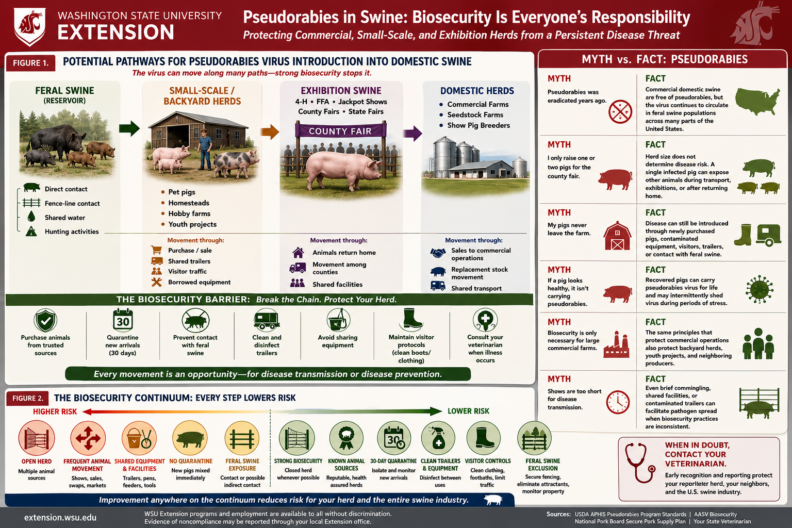
That’s all fine and good, but if you’re like me you may not be up to speed with the ins-and-outs of this disease. So I thought I would put open-source AI to use and asked ChatGPT to provide me with a practical and educational summary article that incorporates scientific and technical information. My prompt was to write an Extension article targeting producers and veterinarians that highlights the importance of managing pseudorabies in pigs, particularly with respect so backyard producers such as those who raise pigs for 4H or FFA. The following article is completely written by ChatGPT with the included infographic its own suggestion. I have to admit that I’m impressed but also a bit overwhelmed by the ease with which an article like this can come together through AI. It also highlights the need to do our best to examine an article such as this for inconsistencies or mistakes. As ChatGPT says, it can make mistakes and we should check important info! That said, I think the following article provides a solid overview and provides some useful points for consideration.
Pseudorabies in swine: Biosecurity is everyone’s responsibility
Protecting commercial, small-scale, and exhibition herds from a persistent disease threat
Craig McConnel
At a glance
Although the United States successfully eliminated pseudorabies virus (PRV) from the commercial domestic swine herd, the virus remains endemic in feral swine populations across many regions of the country. This reservoir creates an ongoing risk for domestic pigs, particularly those raised in backyard, small-scale, and exhibition settings where biosecurity practices may be less formalized. Because youth livestock projects often involve frequent animal movement and commingling, veterinarians, producers, Extension educators, and exhibition organizers all have important roles in maintaining the nation’s pseudorabies-free commercial status.
Why Pseudorabies still matters
For many producers, pseudorabies is viewed as a disease of the past. Following decades of coordinated surveillance, testing, depopulation, and biosecurity efforts, the United States achieved elimination of pseudorabies from commercial domestic swine—a remarkable accomplishment in animal health and disease eradication.
However, elimination from commercial production is not synonymous with eradication. Pseudorabies virus (Suid alphaherpesvirus 1; SuHV-1) continues to circulate among feral swine populations throughout much of the United States. As long as this wildlife reservoir persists, every domestic herd remains vulnerable to reintroduction.
Fortunately, reintroduction is preventable. Success depends upon continued vigilance and implementation of practical biosecurity measures by producers of every size—from large commercial systems to families raising a single market hog for the county fair.
Understanding the disease
Pseudorabies is caused by Suid alphaherpesvirus 1, an enveloped DNA virus belonging to the family Herpesviridae. Unlike many viral pathogens, herpesviruses establish lifelong latent infections. After initial exposure, pigs that recover may harbor the virus indefinitely within nervous tissue and periodically reactivate and shed virus during periods of stress.
Despite its name, pseudorabies has no relationship to rabies virus.
Swine are the natural host, but many other mammals—including cattle, sheep, goats, dogs, cats, and numerous wildlife species—are highly susceptible to infection. In these species, infection is almost invariably fatal and often characterized by severe neurologic disease accompanied by intense localized pruritus (“mad itch”).
Because pigs serve as the maintenance host, preventing infection within domestic swine populations remains the cornerstone of disease control.
Clinical presentation
Clinical disease varies considerably with age and immune status.
Piglets younger than three weeks of age typically develop the most severe disease. Clinical signs include:
- Fever
- Tremors
- Ataxia
- Seizures
- Paddling
- Rapid death
Mortality frequently approaches 100%.
Older pigs often develop:
- Fever
- Depression
- Sneezing and nasal discharge
- Coughing
- Reduced feed intake
- Decreased growth performance
Neurologic disease occurs less commonly but remains possible.
Adult pigs generally experience milder systemic illness but reproductive losses can be substantial, including:
- Infertility
- Early embryonic death
- Abortions
- Mummified fetuses
- Stillbirths
- Weak-born piglets
These reproductive losses may represent the first indication of infection within breeding herds.
Why backyard and exhibition herds matter
Commercial swine operations have invested heavily in biosecurity, routine veterinary oversight, and controlled animal movement. Small-scale operations often face different circumstances.
Backyard producers frequently purchase pigs from multiple sources, have limited quarantine facilities, and may participate in livestock exhibitions that involve repeated movement and commingling. These management differences increase opportunities for disease transmission—even when producers are committed to excellent animal care.
Youth livestock projects deserve particular attention, not because they are inherently high-risk, but because exhibition pigs often experience management practices that differ substantially from commercial production.
A single show pig may:
- Attend multiple fairs during the summer.
- Be housed adjacent to pigs from numerous unrelated farms.
- Travel long distances in shared trailers.
- Return home after each exhibition.
Each movement presents an opportunity for disease introduction if biosecurity protocols are not consistently followed.
These projects remain among the best educational opportunities in agriculture. Strengthening biosecurity protects both the educational experience and the health of every participating herd.
Feral swine: The continuing reservoir
The greatest long-term threat to domestic swine originates from feral swine populations.
Pseudorabies virus remains endemic in feral pigs across many states. Direct contact between domestic and feral swine represents the greatest risk, although indirect transmission through contaminated environments, damaged fencing, shared water sources, hunting equipment, trailers, or clothing may also occur.
Producers should never assume that because their herd is closed, it is protected.
Operations located near feral swine habitat should routinely evaluate fencing integrity and minimize opportunities for contact.
Hunters who pursue feral pigs should avoid entering domestic swine facilities until clothing, footwear, equipment, trailers, and vehicles have been thoroughly cleaned and disinfected.
Practical biosecurity recommendations
Most pseudorabies introductions can be prevented through routine management practices.
Producer checklist
- Purchase pigs only from reputable sources with known herd health status.
- Quarantine newly acquired pigs for at least 30 days.
- Prevent all direct contact with feral swine.
- Maintain secure perimeter fencing.
- Clean and disinfect trailers after every use.
- Avoid sharing equipment between farms.
- Restrict unnecessary visitors.
- Require clean boots and clothing when entering pig areas.
- Keep accurate movement records.
- Consult a veterinarian promptly when unexplained illness occurs.
Considerations for exhibition swine
Preparing pigs for fairs should include preparation for disease prevention.
Before attending exhibitions:
- Confirm all health requirements have been met.
- Avoid taking clinically ill pigs.
- Clean and disinfect trailers before loading.
- Bring dedicated equipment whenever possible.
During exhibitions:
- Minimize nose-to-nose contact.
- Avoid sharing feed buckets and waterers.
- Observe pigs daily for illness.
After returning home:
- Isolate exhibition pigs from the resident herd for an appropriate observation period.
- Monitor carefully for respiratory or neurologic disease.
- Clean trailers and equipment immediately after unloading.
These simple practices substantially reduce the likelihood of introducing infectious diseases following exhibitions.
The veterinarian’s role
Although pseudorabies has become uncommon in domestic practice, veterinarians remain essential for maintaining surveillance.
Pseudorabies should remain on the differential diagnosis list whenever veterinarians encounter:
- Neurologic disease in young pigs
- Unexpected reproductive failure
- Elevated preweaning mortality
- Compatible disease occurring after animal movement or exhibition
- Illness in herds located near feral swine populations
Prompt diagnostic investigation benefits both the affected producer and the broader swine industry.
Veterinarians also play a critical role in educating clients regarding practical biosecurity, exhibition management, and appropriate testing following suspicious clinical events.
Extension’s role in prevention
Extension professionals serve as trusted sources of science-based information for producers of all experience levels.
Educational programming should continue emphasizing:
- Biosecurity planning
- Responsible animal movement
- Exhibition best management practices
- Disease recognition
- Early veterinary involvement
Small improvements in routine management can substantially reduce disease risk.
Key take-home messages
- Commercial freedom does not equal eradication. Pseudorabies remains present in feral swine and continues to threaten domestic pigs.
- Every producer matters. A herd of one pig deserves the same attention to biosecurity as a herd of several thousand.
- Youth livestock programs are part of the solution. Education and practical biosecurity strengthen—not hinder—the success of 4-H and FFA projects.
- Veterinarians remain indispensable. Early recognition and diagnostic investigation are essential for protecting the U.S. swine industry.
- Biosecurity is a daily habit—not a response to an outbreak.
Additional resources
- USDA Animal and Plant Health Inspection Service (APHIS). Pseudorabies Program Standards.
- American Association of Swine Veterinarians (AASV). Biosecurity and disease prevention resources.
- National Pork Board. Secure Pork Supply Plan.
- Secure Pork Supply. Resources for continuity of business and emergency disease preparedness.
- Your state veterinary diagnostic laboratory and Cooperative Extension Service.
Bottom Line
The elimination of pseudorabies from the U.S. commercial swine herd remains one of animal agriculture’s greatest achievements. Preserving that accomplishment requires continued partnership among commercial producers, backyard owners, youth exhibitors, veterinarians, Extension personnel, and regulatory agencies. Regardless of herd size, every producer contributes to the health of the nation’s swine industry. Consistent biosecurity, informed management decisions, and rapid veterinary involvement when disease is suspected remain our most effective tools for ensuring that pseudorabies stays out of domestic swine populations.