By Caio Figueiredo, WSU Veterinary Medicine Extension; Matheus Deniz, São Paulo State University, Botucatu, São Paulo, Brazil; Karolini Tenffen De-Sousa, São Paulo State University, Botucatu, São Paulo, Brazil
Heat stress remains one of the most significant environmental challenges affecting dairy production. Even moderate increases in heat load can reduce feed intake, milk yield, reproductive performance, and animal welfare while increasing the risk of disease and mortality. As temperatures continue to rise and energy costs increase, dairy producers are searching for strategies that improve cow comfort while making more efficient use of farm resources.
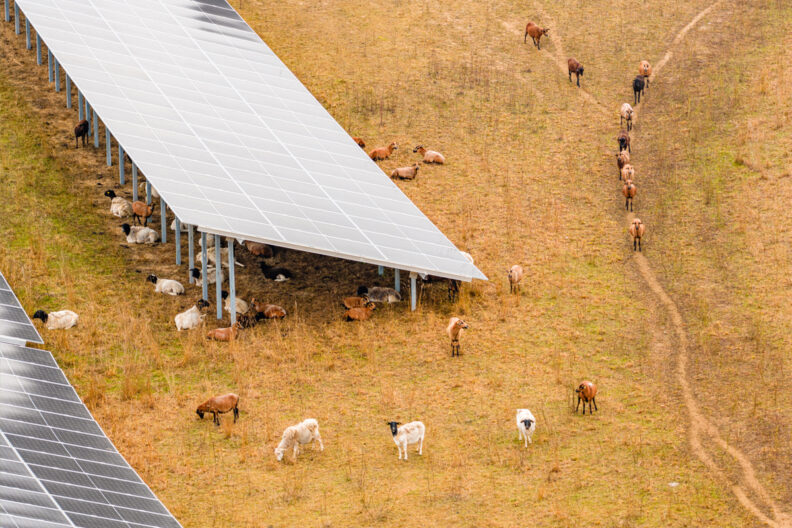
One emerging approach attracting attention is agrivoltaics, which is the integration of solar photovoltaic panels into agricultural production systems. Although originally developed to generate renewable electricity while maintaining agricultural land use, agrivoltaic systems may also provide an additional benefit for livestock by functioning as shade structures.
Unlike conventional solar installations that occupy dedicated land, agrivoltaic systems are designed so that agricultural production continues beneath or around the panels. In livestock systems, photovoltaic panels can simultaneously generate electricity while reducing the amount of solar radiation reaching animals, creating a cooler microenvironment.
Recent research published in JDS Communications evaluated agrivoltaic systems for dairy heifers raised on pasture. Compared with open pasture, both agrivoltaic designs reduced air temperature, black globe temperature, soil surface temperature, and the Black Globe-Humidity Index (BGHI), an indicator commonly used to evaluate heat load in cattle. Average BGHI declined from 74.6 under open pasture to between 70.1 and 71.6 beneath agrivoltaic systems, while soil surface temperatures were reduced by approximately 5 to 8°C. Heifers housed beneath the panels also spent more time lying and ruminating, behaviors generally associated with improved comfort (Sartori et al., 2026).
Importantly, the study did not observe differences in vaginal temperature between treatments. However, this finding should be interpreted within the context of the experiment. The work was conducted during the Brazilian winter under relatively mild environmental conditions, when animals experienced limited thermal challenge. Previous studies conducted under hotter conditions have reported reductions in body temperature when cattle were provided shade from photovoltaic panels, suggesting that the physiological benefits of agrivoltaic systems are likely to become more apparent during periods of greater heat stress.
Although these findings are encouraging, their greatest potential application may not be in pasture-based dairies. Instead, they point toward an opportunity in the large dry-lot dairies that dominate milk production throughout the western United States.
Most commercial dry-lot dairies already invest substantial resources in shade structures because shade is among the most effective methods for reducing solar heat gain in cattle. However, farmers know from experience that artificial shade structures have limitations. Shade cloth requires regular maintenance, is susceptible to damage from wind, rain, and prolonged sun exposure, and eventually needs to be replaced. As a result, these structures represent an ongoing investment in both labor and maintenance. Agrivoltaic systems raise an important question regarding whether dairy farms should build basic shade structures, or those that also produce electricity.
This distinction is important. Rather than viewing photovoltaic panels as an additional investment, producers could eventually replace conventional shade structures with photovoltaic systems that provide multiple services simultaneously. Unlike conventional shade structures, photovoltaic systems are a long-term investment. They typically have a service life of more than 20 years, require relatively little structural maintenance, and generate economic returns through electricity production. Instead of investing in shade alone, farmers could adopt a system that not only improves thermal comfort for their cows but also generates additional income or helps reduce the farm’s electricity costs.
Properly designed systems could reduce solar radiation reaching cows, generate renewable electricity to offset farm energy demands, improve land-use efficiency, and contribute to on-farm sustainability goals. Electricity generated by these systems could help power fans, water pumps, milk cooling equipment, lighting, and other electrical loads already present on modern dairies. In this context, integrating shade with renewable energy generation is no longer simply an innovation, but rather a multifunctional strategy that enhances both farm climate resilience and sustainability. For example, an agrivoltaic system installed on a dairy farm in São Paulo State, Brazil, with 72 photovoltaic modules covering a total area of 144 m², generated 44,210 kWh of renewable electricity between October 2025 and July 2026, corresponding to an estimated avoidance of approximately 21 metric tons of CO₂ emissions. These outcomes demonstrate how a single infrastructure investment can simultaneously improve animal welfare, lower operating costs, reduce a farm’s environmental footprint, and enhance the overall sustainability of dairy production.
Before agrivoltaic systems can be widely adopted in commercial dairy production, however, several important questions remain unanswered. Most published studies have evaluated growing cattle under pasture conditions, whereas the greatest opportunity in the United States likely lies with high-producing lactating cows housed in dry-lot systems during periods of severe summer heat. Research is still needed to determine whether photovoltaic shade can improve milk production, feed efficiency, reproductive performance, health, and longevity under commercial conditions.
Economic considerations will ultimately be equally important. Installation costs, structural design, maintenance requirements, electricity generation, available incentives, and return on investment must all be evaluated before producers can determine whether agrivoltaic shade represents a practical alternative to conventional shade structures. Engineering considerations, including panel height, orientation, durability, manure management, and compatibility with dairy equipment, will also influence successful implementation.
As interest in renewable energy continues to grow, agrivoltaic systems offer an opportunity to rethink one of the oldest heat-abatement tools available to dairy producers. Shade has long been recognized as an essential component of cow comfort. If future research demonstrates that photovoltaic shade can provide comparable or superior thermal protection while generating renewable electricity, agrivoltaics could represent the next generation of shade infrastructure for commercial dairy farms.
The concept remains in its early stages, but the direction is clear. Future research should focus on evaluating agrivoltaic systems under the environmental, engineering, and management conditions that characterize western U.S. dairies. If successful, these systems could help producers address two increasingly important challenges simultaneously: mitigating heat stress and improving energy sustainability.
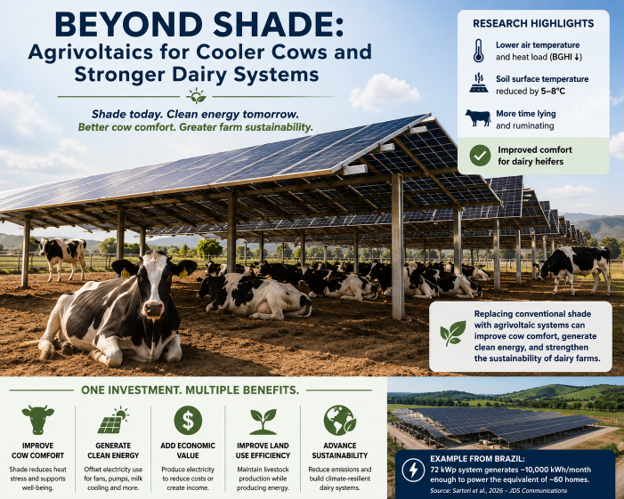
Image created using Chat GPT from OpenAI