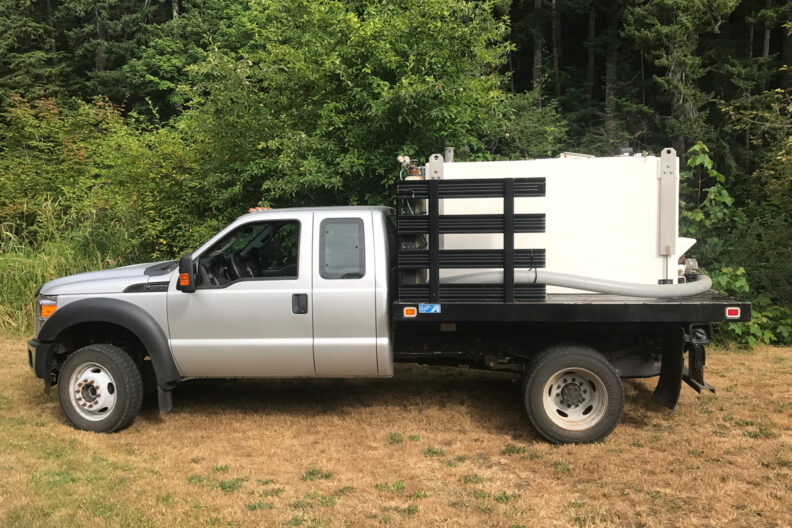
Before hauling
The equipment
The first step for successful fish transport begins with ensuring fish transport equipment is in good condition and ready for the journey. This includes checking the vehicle, tires, and hauling tanks. If the hauling set up includes dissolved oxygen monitoring, confirm that the system is working and calibrate it if necessary. This is especially important if the equipment hasn’t been used recently, as sensors can dry out and become inaccurate. Oxygen delivery equipment should also be checked. Oxygen delivery hoses can get brittle with UV damage and are a common point of failure. Clogged diffusers can be opened using sandpaper (or acid baths for specific types of diffusers).
Reminder: Make sure the appropriate type of diffuser is being used for the oxygen delivery method. There are two main types of diffusers used in aquaculture settings, air diffusers and pure oxygen diffusers. Air diffusers produce large, coarse bubbles that agitate the surface of the water to introduce oxygen. Pure oxygen diffusers produce fine bubbles that transfer oxygen directly from the bubble into the water.
Aerators: Aerators can be useful to maintain water movement during hauling, especially for species that are constantly-swimming such as pallid sturgeon. They can also help with removing carbon dioxide buildup in the water. However, for systems where pure oxygen is being added, aerators can remove oxygen from the water if they are providing too much agitation.
Equipment that will come into contact with fish, including containers, nets, and gear, should be properly disinfected prior to hauling. A major consideration when disinfecting hauling tanks is disinfectant corrosiveness. Many hauling tanks are metal and susceptible to corrosion from disinfectants like bleach. Some operations will forgo chemical disinfectants completely and use hot water, sunlight, and drying as disinfection methods. Other operations may use corrosive disinfectants but neutralize them after the required duration to minimize damage (ex: inactivating bleach with sodium thiosulfate). Disinfectant choice will vary based upon individual facility operating parameters, and the Southern Regional Aquaculture Center’s “Biosecurity in Aquaculture, Part 1: An Overview” publication is a good starting place for evaluating disinfectant suitability for your circumstances.
Reminder: Disinfection is a task that needs to be planned and performed in advance of the day that hauling is scheduled. Effective disinfection involves more than just applying a chemical disinfectant to a piece of equipment and calling it good. Essential steps in the disinfection process include removal of debris and organic matter, cleaning (aka elbow grease), thoroughly applying the disinfectant and allowing it to work for the necessary duration, and complete rinsing and drying.
The water
Water added to the hauling tank should be close in temperature to the water the fish are being held at. A general rule of thumb is that fish should not be transferred into water that is greater than 5°C (9°F) colder or 2°C (4°F) warmer. For greater temperature differences, fish should be acclimated and not directly transferred.
To salt or not to salt: There have been passionate debates between fish health professionals about the addition of salt to hauling tank water. Proponents of salt addition tout its value as an osmoregulatory stress reducer. Opponents implicate it as a cause of corrosion to metal hauling containers. We will not take a side on this fraught topic except to provide the following two insights:
- For salmonids, hauling at salinities up to 10 ppt is routine practice for many operations.
- Rinsing the hauler with fresh water after draining can remove salt and prevent corrosion.
The fish
Ensure that fish are healthy before beginning their journey. Sick fish should not be moved and should be evaluated before commencing with any transport activities. Sick fish are both unlikely to tolerate transport well and have a higher risk of carrying pathogens that they could introduce to the transport destination.
Reminder: If hauling fish across state or international boundaries, make sure that appropriate permits, health certificates, and pathogen testing are completed in advance of the fish movement. Requirements for interstate fish movements can range from being non-existent to requiring extensive laboratory testing and a veterinary inspection. Do not hesitate to reach out to WADDL’s Aquatic Health Laboratory with questions about laboratory testing for interstate and international fish movements.
Successful hauling densities range widely by species, circumstance (temperature and life stage), and operator. Good resources for specific hauling density recommendations include Fish Hatchery Management (1e), Fish Hatchery Management (2e), technical fact sheets, and review papers. Hauling densities that work for one operator may not work for another, and the measure of success is fish health and welfare during and after hauling. Shipping stress can manifest up to three weeks after the transport event and any fish mortalities within this time should be evaluated in the context of the recent transport event.
Feed should be withheld at least one day prior to moving and longer if possible to reduce ammonia accumulation during hauling. Many fish species and life stages can tolerate significantly longer periods without feed.
During hauling
Loading
There are many different methods for loading fish into a hauler, including nets, screen buckets, and fish pumps. Water-to-water transfers are best practice, as they significantly reduce stress and physical trauma to fish during the loading process. While expensive, fish pumps are often an investment in fish health and welfare (as well as people’s backs!).
To treat or not to treat: Applying treatments during hauling is another hotly contested topic. Treatments can range from sedating fish with tricaine methanesulfonate (MS-222) or isoeugenol (AQUI-S) to applying vaccines during transport to adding chemicals that kill aquatic invasive species. Every treatment has risks and adverse effects, and these can be amplified when the treatment is applied in a small, closed system like a hauling tank. Hauling tanks can be easier to overdose, more complicated to monitor, and harder to impossible to intervene in if fish react poorly to a treatment. In the case of vaccines, the stress of hauling may interfere with fish mounting an adequate immune response. In general treatments are probably best avoided during hauling. If conducting a treatment during hauling is unavoidable, it should be planned and performed in consultation with a fish health professional.
Monitoring
During hauling, monitoring fish behavior and key water quality parameters is crucial to success.
- Fish behavior: Fish should be checked every 1-2 hours when hauling. The hauler should assess markers and behaviors such as operculation (how fast are fish gilling), position in the water column, and response to stimuli. Common signs of stress include gasping at the surface, laying at the bottom of the tanks, rapid respiration, pale gills, bloody gills (ammonia toxicity), and buoyancy issues. In addition to fish behavior, the hauler should check water level and ensure water quality probes are in an appropriate position and working properly.
- Dissolved oxygen: This parameter should be monitored constantly while hauling using a dissolved oxygen meter, either incorporated into the hauling system or a handheld unit. Measuring oxygen initially is not adequate monitoring. Oxygen may appear sufficient prior to adding fish, but once fish are added it can decrease precipitously. Constantly monitor the dissolved oxygen throughout hauling and maintain the dissolved oxygen as close to 100% saturation as possible. Supersaturation is always a risk, especially when hauling fish to higher elevations–the supersaturated gas can easily come out of solution at higher elevations and cause gas bubble disease.
- Carbon dioxide: This parameter is often not directly monitored, but high carbon dioxide levels can cause metabolic perturbations. Aeration and circulation will help with carbon dioxide reduction, but hauling systems with pure oxygen delivery may have problems with carbon dioxide buildup and may need to more closely evaluate this parameter in the system.
- Temperature: Temperature can change significantly during the course of hauling, especially for extended journeys. Warm water holds less oxygen than cold water, so rising temperature can contribute to lower dissolved oxygen levels during hauling. Temperature should be continuously monitored during hauling, and ice and chillers can be used to prevent water temperatures from increasing during the trip.
- Ammonia: Ammonia can build up in haulers, especially if fish were not adequately fasted prior to the trip. At higher water temperatures, fish excrete more total ammonia and more of that is in the toxic fraction. There are products that can be added to hauling water that claim to detoxify ammonia, but their efficacy and safety is unknown.
After hauling
Release
Tempering water is a critical part of successful hauling. The water in the hauler often will not match the receiving water in temperature, pH, dissolved gases, hardness, and salinity. Temperature is often the easiest-measured and most-apparent difference, and specific recommendations for temperature changes exist in resources previously mentioned in this article. Other water chemistry differences may not be as easily-measured, and there is not as much guidance about managing differences.
Sudden changes in temperature and water chemistry can cause acute mortality or long-term morbidity stemming from a suppressed immune system. Logistics and time may limit the duration of acclimation, but it should be noted that the longer fish can adjust to the receiving water source, the better the odds are for their long-term success. Raising fish takes a lot of time and effort, don’t let rushing the acclimation process be the reason they die.
Just as with moving fish into the hauler, moving fish out of the hauler can cause significant stress to the fish (and the people!). Water-to-water transfers are always superior to removing fish from water for all fish movements, whether between rearing containers at the hatchery or into and out of haulers. Hoses and slides can be useful for transitioning fish down from a height without dropping them directly onto the surface of the receiving water. The extra time or effort required to move fish in ways that minimize stress and trauma are good investments for the long-term success of fish post-hauling.
Acknowledgements
Thank you to Jake Veilleux, Garrett Gertz, and Jeff Powell for their contributions.
References
- Jensen, G.L., 1990. Transportation of warmwater fish: procedures and loading rates. Southern Regional Aquaculture Center (SRAC) Publication 0392 [online]
- Jensen, G.L., 1990. Transportation of warmwater fish: loading rates and tips by species. Southern Regional Aquaculture Center (SRAC) Publication 0393 [online]
- Luz, R.K. and Favero, G.C., 2024. Use of salt, anesthetics, and stocking density in transport of live fish: A review. Fishes, 9(7), p.286.
- Northwest Indian Fisheries Commission, 2015. NWIFC Recommendations for Broodstock Season to Optimize Survival.
- Piper, R.G., 1982. Fish hatchery management. US Department of the Interior, Fish and Wildlife Service.
- Wedemeyer, G., 2001. Fish hatchery management.
- Wynne, F. and Wurts, W.A., 2011. Transportation of warmwater fish: equipment and guidelines. Southern Regional Aquaculture Center (SRAC) Publication 0390 [online]
- Yanong, R.P. and Erlacher-Reid, C., 2012. Biosecurity in aquaculture, Part 1: An overview.