By Alex Pace, WSU Veterinary Medicine Extension
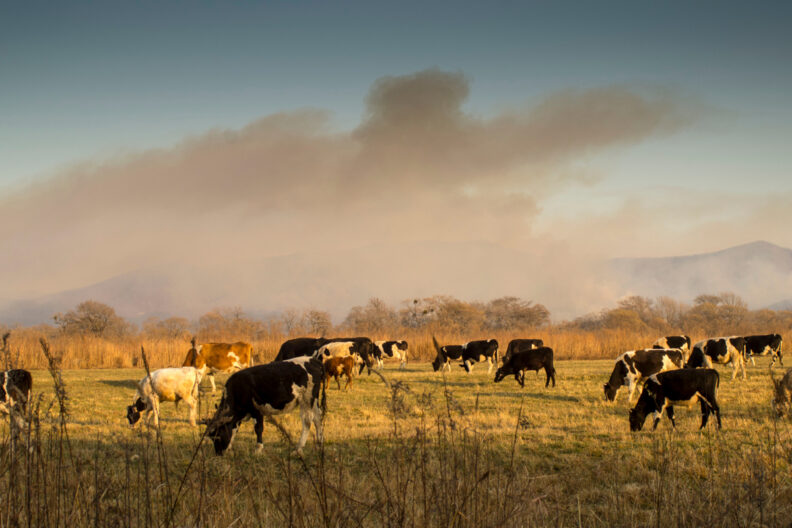
Wildfires occur annually in the Pacific Northwest and they obviously produce smoke, which contains a complex mixture of air pollutants, such as fine particulate matter (PM2.5) and gases like volatile organic compounds (VOC). These pollutants can harm human and animal health. Research presented at the 2026 American Dairy Science Association annual meeting evaluated the responses of dairy cattle to pollutants found in wildfire smoke.
- Exposure to wildfire smoke PM2.5 early in life may have long term effects on calf health and development. Holstein heifer calves naturally exposed to wildfire smoke PM2.5 in the pre-weaning period were compared with calves that were exposed to low concentrations of PM2.5 in the pre-weaning period. Exposed calves had increased lung consolidation and signs of systemic inflammation shortly after smoke exposure and altered growth and lung function in the months following smoke exposure (Sarantopulos et al., 2026; Gomez-Pachecho et al., 2026).
- Reduced milk production has previously been reported in early lactation cows exposed to wildfire smoke PM2.5. Sampaio et al. (2026) found that Holstein cows naturally exposed to wildfire smoke PM2.5 in mid-lactation had lower milk production and milk urea nitrogen during and following exposure to wildfire smoke compared with before exposure.
- Although PM2.5 is known to impact cows and calves, wildfire smoke also contains different types and concentrations of VOC, depending on the fuel source and fire conditions. Early lactation Holstein cows and pre-weaned heifer calves were followed over two wildfire seasons. Twenty-four VOC were measured across the study, along with PM2.5, temperature, and humidity conditions. Separate wildfire smoke events had distinct VOC profiles that showed different associations with vital signs and immune cell counts in cows and calves (Pace et al., 2026).
- Previous research has investigated responses of cows and calves to air pollutants in wildfire smoke in field conditions. Experimental chambers were designed to expose calves to wood smoke while controlling temperature and humidity conditions. Pre-weaned Holstein bull calves exposed to wood smoke for six hours showed signs of lung inflammation with changes in lung function immediately after exposure compared with calves that were not exposed to wood smoke (Kamyabi et al. 2026).
These studies suggest that wildfire smoke emissions may have short and long-term effects on dairy cattle health and production at different life stages. Current guidelines for producers affected by wildfire smoke can be found at the Livestock and Wildfire Hub.
References
- Gomez Pacheco, X., D. Sarantopulos, J. Cruickshank, S. Lepiane, A. Pace, M. Kamyabi, L. De moura Pereira, P. Rezamand, and A.L. Skibiel. 2026. Long-term effects of early life exposure to wildfire smoke on growth and metabolism of dairy calves. J. Dairy Sci. 109 (Suppl. 1): 321. (Abstr).
- Kamyabi, M., D. Sarantopulos, A. Pace, L. Christensen, A.S. Marquez Acevedo, L. De Moura Pereira, M. Larson, A. Ahmadzadeh, D. Konetchy, P. Rezamand, and A.L. Skibiel. 2026. Respiratory and immune responses to controlled wood smoke exposure in pre-weaned dairy calves. J. Dairy Sci. 109 (Suppl. 1): 11. (Abstr).
- Pace, A., N.A.C. Johnston, C. Sia, L. Johnston, D.D. Miller, K. Mirkin, and A.L. Skibiel. 2026. Lactating cow and preweaned calf responses to volatile organic compounds in wildfire smoke. J. Dairy Sci. 109 (Suppl. 1): 320. (Abstr).
- Sampaio, P.A., M.C. Tamiozzo, D.S. Almeida, M. Kamyabi, A.L. Skibiel, and i.A.M.A. Teixeira. 2026. Wildfire smoke exposure reduces milk urea nitrogen and milk production in mid-lactation dairy cows. J. Dairy Sci. 109 (Suppl. 1): 381. (Abstr).
- Sarantopulos, D., J. Cruikshank, S. Lepane, M. Kamyabi, A. Pace, L. De Moura Pereira, J. Ranches, D. Konetchy, P. Rezamand, and A.L. Skibiel. 2026. Effects of wildfire-PM2.5 on dairy calf growth, pulmonary function, and health. J. Dairy Sci. 109 (Suppl. 1): 11. (Abstr).