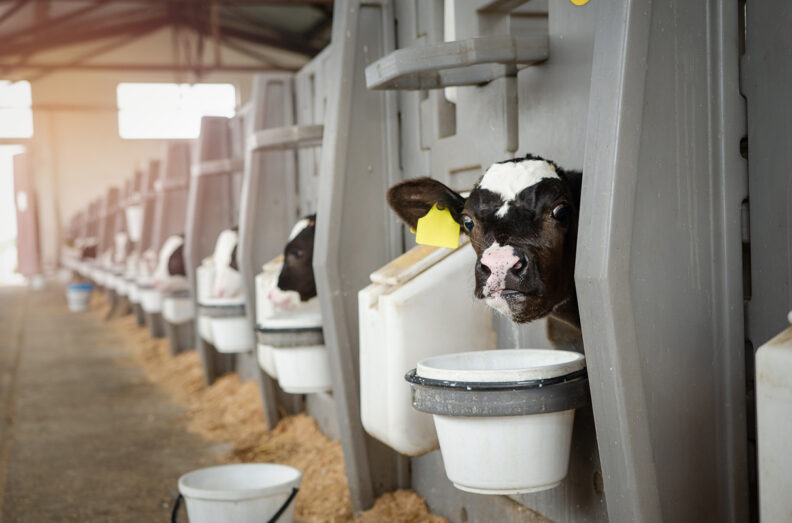
Earlier this year we published an article covering some key points related to the detrimental impacts of heat stress on the development, health, and performance of dairy cattle (Figueiredo, 20251). One of the main takeaways from that article is that optimization of heat stress abatement strategies is required, considering the projected increases in global temperatures. That said, most of the literature regarding heat stress abatement has been generated using post weaned dairy heifers and cows, which leaves a gap of knowledge regarding the optimization of heat stress abatement in dairy calves. A recent publication from Journal of Dairy Science touches on this subject by testing a positive pressure tube ventilation system for heat abatement of outdoor preweaning heifers (Guenther et al., 20252).
The photographic representation of the system is available in Figure 1, and aside from the novelty of the system, it seems to be fairly easily applied within dairy settings. Overall, the positive pressure tube ventilation (PPTV) system generated greater airspeeds than the CON-HS pens (Figure 2), and reduced the microenvironment ambient temperature and THI within the pen, leading to reductions in sand bedding temperature without affecting relative humidity (Figure 2). Differences in animal behavior were also associated with PPTV, illustrated by decreased respiratory rates and skin temperature compared to calves that were not exposed to the PPTV system (Figure 3). Although more studies are required to effectively test the capacity of PPTV systems to abate heat stress in dairy calves in larger populations, this collaborative work between the University of Wisconsin-Madison and University of Georgia may have shed light on a promising path moving forward.
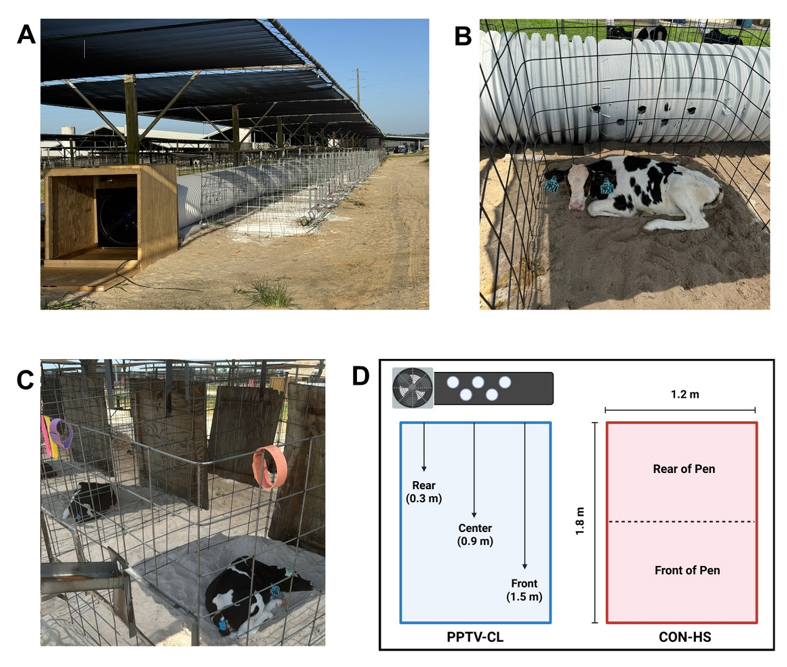
Figure 1. (A) Photographic representation of the positive pressure tube ventilation (PPTV) system designed for dairy calves housed outdoors in wire pens. Photographic representation of (B) a heifer exposed to the PPTV system (PPTV-CL) lying near the air outlets within a wire pen and (C) heifers under an adjacent shaded area without the PPTV system (CON-HS). (D) Pictographic representation of the wire pen dimensions and sampling distances for airspeeds (rear = 0.3 m, center = 0.9 m, front = 1.5 m relative to the back of the pen) as well as front and rear of pen designations for calf standing and lying behavior. Airspeed and lying and standing postures and location were taken for both the PPTV-CL (blue) and CON-HS (red) calves. Adapted from Guenther et al., 20252.
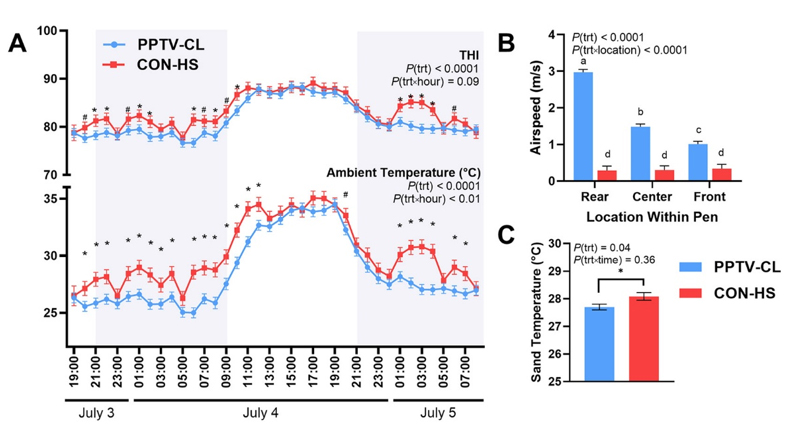
Figure 2. (A) Hourly average temperature-humidity index (THI) and ambient (dry-bulb) temperature of the local microenvironment of wire pens with positive pressure tube ventilation system for cooling (PPTV-CL, blue lines and circles) or pens not provided PPTV (CON-HS, red lines and squares) in Quitman, Georgia. The period evaluated was from 1900 h on July 3 to 0800 h on July 5, 2024. Gray areas indicate nighttime and white areas indicate daytime and addition of misters to the tube system. (B) Airspeed and (C) sand bedding surface temperature of PPTV-CL (blue bars, n = 12) or CON-HS heifer pens (red bars, n = 6). Adapted from Guenther et al., 20252.
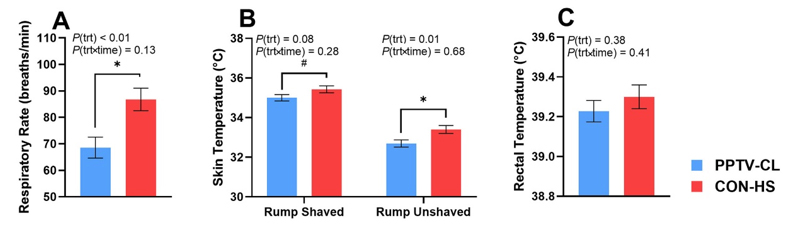
Figure 3. (A) Respiratory rate, (B) skin temperatures, and (C) rectal temperature of heifers exposed to heat abatement from a positive pressure tube ventilation system (PPTV-CL; blue bars, n = 24) or not (CON-HS; red bars, n = 21). Thermoregulatory measures (A–C) were measured twice daily for 3 d across the study period (June 30, 2024–July 6, 2024; time). Adapted from Guenther et al., 20252.
Citations
1