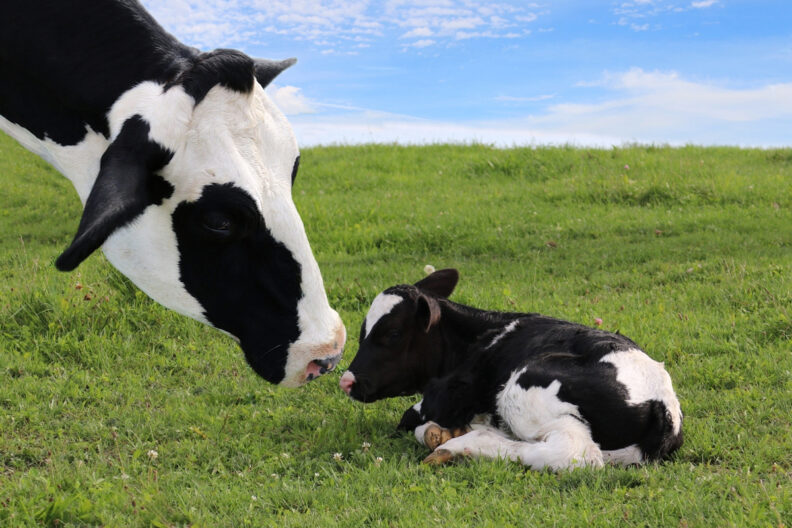
One of the more enjoyable parts of my job comes from ongoing collaborations and communication with folks who have similar academic interests. I’ve been involved in researching causes of dairy cow mortality for years now and have been lucky enough to get to know Dr. Peter Thomsen who is one of the few other individuals focused on dairy cow mortality. Dr. Thomsen works for the Department of Animal and Veterinary Sciences at Aarhus University in Tjele, Denmark and recently published a paper exploring early-life risk factors associated with dairy cow longevity (Journal of Dairy Research , Volume 92 , Issue 4 , November 2025 , pp. 525 – 530).
I mentioned in last Fall’s newsletter that here at WSU we continue to research burdens of disease including the long-term effects of calf disease on productivity, longevity, and subsequent disease responses. In Denmark, much of the discussion about longevity is linked to the climate footprint per liter of milk produced over a cow’s lifespan. Of course, a consideration is that the incidence of diseases increases with age, and this affects animal welfare. As Dr. Thomsen says, “Optimal longevity is not necessarily about making the cow live as long as possible.”
Denmark has incredible control of records related to nationwide cattle inventories inclusive of production metrics and morbidity and mortality outcomes. In fact, Danish farmers are required by law to report all cattle deaths to the Danish Cattle Database, which is managed by the Danish Cattle Federation. Since 2007, this reporting must distinguish between cows that died unassisted and those that were euthanized. Furthermore, Danish dairy farmers are required to report additional information to the Danish Cattle Database including dates of calvings, slaughter, deaths and all movements of animals between herds. Likewise, farmers must report the sex and number of calves born. Farmers can also report the size of the calf, which is not mandatory but is done in approximately 80% of cases. Among many other additional things, the Danish Cattle Database also includes information about the cow’s breed.
Given this level of national herd data, it isn’t surprising that the study referenced above included more than 80% of the approximately 931,000 Danish dairy cows culled during the five-year period studied (2019-2023)! Although Danish dairy management has clear and substantial differences to our conventional systems in the western U.S., it is still worth noting that the results from Dr. Thomsen’s study demonstrated the importance of ‘a good start’. Cows with a difficult start to life such as being born as a twin or of a small size generally had decreased longevity, irrespective of whether longevity was measured as the length of productive life or as lifetime milk yield. As you might imagine, cows removed in their fifth or later lactations had a milk yield per day of life which was approximately three times higher than cows culled during the first lactation. The merits of that can be debated relative to sunk costs associated with raising heifers versus removing cows to make room for higher quality individuals. Regardless, the primary takeaway from this study was to identify and act on those risk factors that can be relatively easily (in terms of labor and investments) changed, eliminated or mitigated (e.g., age at first calving), versus others that are not manageable in the same way (e.g., calf size, twinning). Knowledge about the association between such risk factors and longevity may be used as a decision support tool when farmers need to make an early selection between two otherwise ‘equal’ replacement heifers: which one to keep and which one to sell.