Current challenges and new opportunities for abatement
If you regularly read WSU Veterinary Medicine Extension newsletters and articles, you may recall our recent discussion on the effects of heat stress on dairy cattle development, health, and performance (Figueiredo, 2025a). As emphasized in that article and throughout the broader literature, heat stress represents one of the most significant challenges facing modern livestock systems. Projections indicate that this problem will continue to intensify as global temperatures rise, underscoring the urgency of developing new heat abatement strategies and optimizing those already in use. Doing so is essential not only for sustaining livestock production systems, but also for safeguarding animal welfare, health, and productivity.
Accordingly, researchers continue to devote substantial effort to improving heat abatement technologies and reducing the limitations associated with existing approaches. Last year, we highlighted a recent publication describing a newly developed heat stress abatement strategy for preweaned calves with potential to substantially influence calf management and long-term performance outcomes (Figueiredo, 2025b). Despite this encouraging progress, significant challenges remain for cooling dairy cattle, particularly under commercial production conditions.
Historically, the primary strategies used to mitigate heat stress on dairy farms have included shade, ventilation, sprinklers, and misting systems. These approaches are designed to reduce heat load through convective and evaporative cooling. Although they vary in efficacy, they also differ in their practical constraints. Shade structures and ventilation systems reduce radiant heat gain and enhance air movement, but their success depends heavily on facility design and the ability to maintain adequate airflow. Sprinklers and soakers, typically paired with fans, improve evaporative cooling by wetting the cow’s hide so that heat is removed as water evaporates. However, a major and growing concern with these systems is water use. Traditional evaporative cooling methods often require large volumes of water, increasing operational costs and raising sustainability concerns, particularly in regions facing water scarcity.
A newly published article in JDS Communications (Casarotto et al., 2025) explores a novel cooling strategy centered on improving water-use efficiency rather than relying on continuous or broad water application. Instead of running sprinklers in blanket patterns, water was delivered in a more controlled, minimal, and behaviorally informed manner. Preliminary results indicate that this precision cooling approach can maintain indicators of animal comfort, including respiratory rate, rectal temperature, feed intake, and milk yield, while substantially reducing water and energy use (Figure 1). These findings suggest that targeted cooling strategies may simultaneously support animal welfare and resource conservation. Heat stress in dairy cows remains a pervasive challenge that compromises productivity, reproductive performance, and animal well-being. Although conventional tools such as shade, fans, and sprinklers continue to form the backbone of heat abatement programs, their limitations highlight the need for innovation. The strategy described in the recent JDS Communications article prioritizes efficient, targeted water application combined with enhanced monitoring, positioning it as a promising addition to the heat stress mitigation toolbox. By integrating precision cooling with smart data capture, producers may be able to achieve more effective abatement while lowering resource inputs and improving cow outcomes. Producers, industry advisors, and Extension personnel should consider piloting such approaches on farms with the technological capacity to evaluate impacts on thermal comfort, water and energy use, and overall productivity.
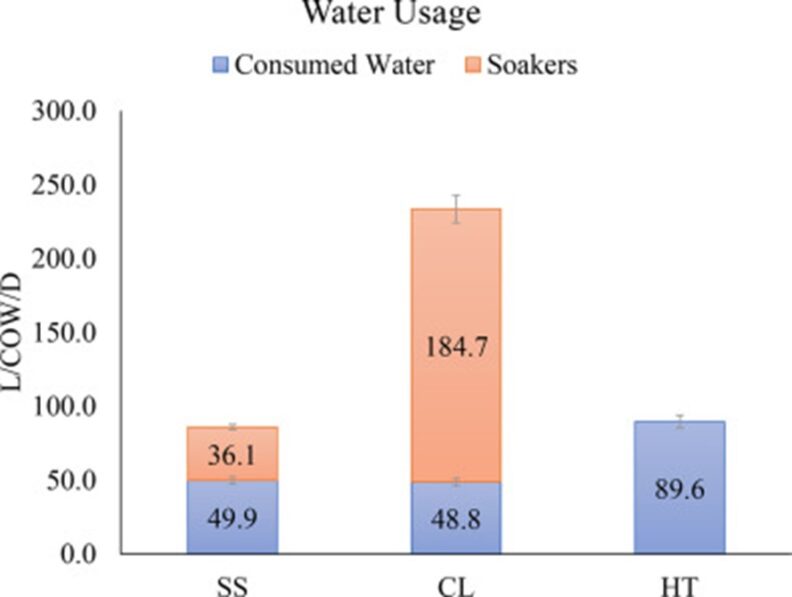
Figure 1. Animal consumed water and soaker output daily (L/cow/day) in the groups with SmartSoaker cooling system (SS), traditional active cooling system (CL), and heat stress (HT) during the dry period. Adapted from Casarotto et al., 2025.