By Kyle Topp (Advisor: Dr. Marcie Logsdon)
Summary: The purpose of this paper is to provide baseline knowledge in providing care to backyard poultry to general practice veterinarians. This paper will provide basic information for performing an examination, performing diagnostics, and identifying common diseases. Due to the growth and continuation of both hobby farms and backyard poultry, many clients are seeking out veterinarians who are willing to provide care for their birds. There is a need for veterinarians who are willing to provide medical care, husbandry education to owners, improve human health and help prevent zoonotic disease spread and food borne illnesses. This paper will provide basic information on examining poultry and developing a baseline knowledge for further treatment.
A Preface to Poultry Medicine
It must be acknowledged that poultry are food animals, and must be treated as livestock, regardless of if the owner uses the animal for its eggs or meat. Certain duties performed with livestock species require Category II National Veterinary Accreditation Program (NVAP) accreditation in order to administer Animal and Plant Health Inspection Service (APHIS) duties related to animal health2. Furthermore, it must be recognized that there are certain drugs that cannot be used in livestock. These lists can be obtained through the Food Animal Residue Avoidance Databank via FARAD.org, and should always be considered before prescribing medication to livestock. Any drugs that are prescribed should also be explored for their withdrawal period, as eggs will often need to be discarded for a period after drug administration for human health and safety. This information can often be found on the drug label or can be requested through FARAD when using in an extra label manner.
Examining Poultry
The examination should begin with a thorough history followed by an assessment of the bird’s general appearance. The history should include information regarding changes in feed intake, energy levels, if other members of the flock are affected, if the bird has been laying regularly (one egg per day on average), and what husbandry/management practices are being implemented. These questions can help provide clues to what the cause of the symptoms may be, and aid in moving forward with the diagnostic process. When beginning a physical examination, first examine the bird from a distance without any handling. A healthy bird should stand upright and alert, looking around and very attentive to their environment. Sick birds will often be separated from the flock, show reluctance to move, and may show fluffed feathers1. After examining the bird from a distance, a thorough physical exam can be performed. Proper restraint must be utilized to avoid harming the animal.
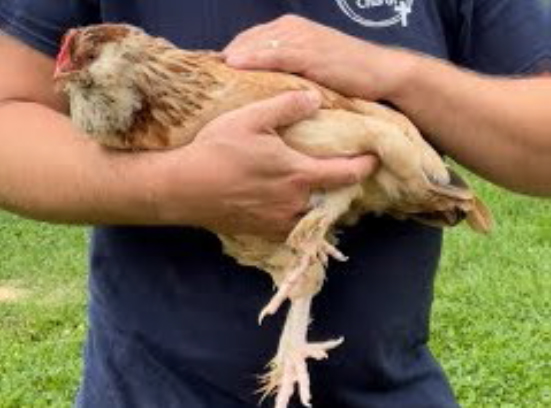
To properly hold a chicken for examination, place one hand over the back to secure the wings down, then place the other hand under the bird, with the middle and ring finger between the legs and the pinky and index fingers restraining the legs on the outside (see Figure 1).
Avoid holding the bird upside down as this may lead to regurgitation and subsequent aspiration pneumonia1.
Performing Diagnostics
When investigating poultry for disease, blood draws and swabs may need to be collected for further send-off testing. Understanding where blood can be drawn, and appropriate methods of collection are necessary for a good diagnostic sample to be achieved.
Venipuncture
When collecting blood, first consider that 10% of the body weight is blood volume, and no more than 10% of that volume should be collected in a healthy animal, therefore no more than 1% of a bird’s weight in blood should be drawn2, 5. Collection sites vary between species and the age of the animal, but the wing or brachial vein is the most common site for venipuncture in poultry5. When collecting blood from waterfowl, the metatarsal vein is the ideal choice. Samples meant for hematologic or biochemistry analysis should be placed in EDTA or heparinized blood tubes. It is important to check with the lab to which the sample is being sent for the type of tube they request, as some avian blood has been noted to lyse in EDTA. When sending off avian blood samples it is recommended to also send a blood film, as artifacts on the blood cells may appear with anticoagulants2. Immunologic tests samples should be collected aseptically in tubes without anticoagulants, separator tubes, or other non-EDTA/heparin tubes2.
Swabs
The most common sites for collecting a swab sample are the oropharynx or choana, and the cloaca. When collecting oropharyngeal swabs, the bird should be held securely by being restrained under the handler’s arm in an upright position. One hand is used to open the beak while the other hand swabs the oropharynx and choanal cleft, collecting as much mucus as possible and avoiding blood, if present2. With cloacal swabs, the bird should be restrained securely, as the tail feathers are lifted to expose the cloaca. The swab should then be inserted slightly, and excess fecal removal gently shaken from the swab2.
Sedation
For minor wounds, sedation using 2-3 mg/kg of butorphanol and 0.5 mg/kg of midazolam is appropriate7. Local or regional analgesia can be provided using 2 mg/kg of lidocaine3. It should be noted that birds are more sensitive to lidocaine than mammals, and doses higher than this have been associated with toxicity. For further pain management, meloxicam can be administered at 1 mg/kg orally every 12 hours3. One study found meloxicam residue in egg yolks 8 days after administration4, but for a confirmed withdrawal time FARAD should be contacted. Tramadol may show promise in poultry pain management, but further research is required to understand the effects and behaviors of this drug in poultry.
Conclusions
Taking on poultry patients does not need to be intimidating, and many cases only require a baseline knowledge, and the confidence to use resources when needed. This paper was written to provide baseline knowledge for examining poultry, performing diagnostics, recognizing common problems, and providing medical care. In areas where referrals are not available, it is crucial to have the ability to learn and adapt to provide care to the animals we have taken an oath to protect, as well as providing the knowledge for safe care and handling for the owners.
References
- 1 Lossie, Geoffrey. “Performing a Physical Exam on a Chicken.” Ohioline, Ohio State University Extension , 19 Feb. 2019.
- 2 Crespo, Racio, and H. L. Shivaprasad. “Chapter 26: Diagnostic Laboratory Sampling.” Backyard Poultry Medicine and Surgery, Second ed., John Wiley & Sons, Inc., Hoboken, New Jersey, 2021.
- 3 Lennox, Angela. “Chapter 15: Dermatological Diseases.” Backyard Poultry Medicine and Surgery, Second ed., John Wiley & Sons, Inc., Hoboken, New Jersey, 2021.
- 4 Souza, Marcy J., et al. “Pharmacokinetics and egg residues after oral administration of a single dose of meloxicam in domestic chickens (gallus domesticus).” American Journal of Veterinary Research, vol. 78, no. 8, Aug. 2017, pp. 965–968.
- 5 Kelly, L., Alworth, L. “Techniques for collecting blood from the domestic chicken.” Lab Anim 42, 359–361 (2013).