My Veterinary Medicine Extension mentors Dr. Dale Moore and Dr. Bill Sicho did some foundational research into calf management much of which is covered within our Veterinary Medicine Extension Calf Science portal. One of the articles focused on transportation of the newborn to the calf-rearing facility.
Key points from that 2010 article were as follows
- Make sure calves are dry and receive colostrum before transport
- Provide plenty of bedding for solid footing, warmth and comfort
- Provide about 4 ft2 per calf in the trailer
- Don’t force them to walk or jump – use a calf cart or carry
I thought I’d revisit this topic based on recent work by our colleagues at The Ohio State University and Texas A&M. Dr. Schuenemann and Dr. Piñeiro published an article in the Journal of Animal Science entitled, “Short- and long-distance transport: health, survival and growth of preweaned dairy and dairy-beef calves.” Key points from the article were that:
- The death rate of calves upon arrival was very low (0.015%; 58/392,064) and was not affected by transport duration.
- The overall death rate by weaning was 2.5% and varied with transport duration.
- Calves fed two colostrum meals experienced less diarrhea events and had less mortality before weaning.
- Replacement dairy heifers born in the south experienced higher mortality at weaning compared to dairy heifers born in the north or dairy/beef crossbred calves.
The main factors linked to calf loss were diarrhea, calf immunity, transport duration, pneumonia, birth season, birth year, and gestation length. The authors concluded their lay summary by stating that their study did not prove that transport duration directly causes changes in survival or growth, but that it did show that other health-related factors such as calf disease, colostrum management, calf type, birth season or year play a much larger role in calf mortality at weaning than transport duration when following well-established fit-for-transport practices.
If we dive into the Results and Discussion a bit further the story becomes more focused. But first we need to define the transportation logistics given they are the focus of the research. For calf transport lasting 17 and 24 h, each trailer was operated by a team of two drivers with two short stops. All calves were transported in a single continuous drive without unloading. The process of loading calves in and out of trailers at the maternity and collection centers was one of the best parts of this study. Additional details are described within the article, but Figure 1 provides a visual and description of the excellent set-up focused on appropriate handling and safety for both calves and operators.
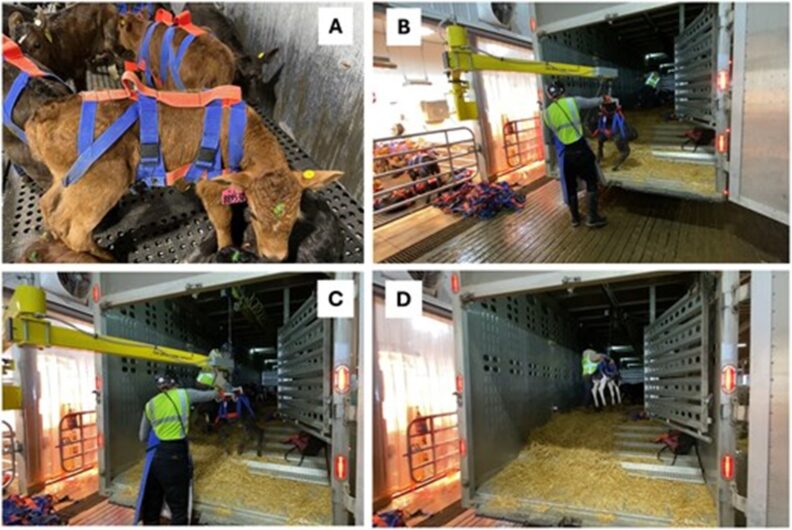
Figure 1: Each individual calf was fitted with a strap harness (A). Once the trailer arrived at the maternity, an operator loaded each calf individually using a Conco® articulating arm lifter fitted with a winch connected to a hook (B). Transportation trailers were also fitted with rail mounted inside the roof with a moving winch connected to a hook (C). The hook fitted to the outside lifter arm was wider than the hook fitted to the trailer allowing to gently handle the calf in and out of the trailer (D). At least two operators fitted with protective equipment (e.g., helmets) worked as a team, one inside the trailer and one outside, to load and unload calves.
Here’s where we get to the crux of the project. Dairy replacement heifers were transported 0.5 or 24 h (10 or 830 km, respectively), whereas dairy/beef crossbred calves (male and female) were transported 8 or 17 h (830 or 1700 km, respectively). This was because although the calves were under similar management from birth to weaning, they were born within two distinct geographical regions. The north system consisted of 14 dairy farms located in South Dakota and Minnesota (n = 249,172 calves), whereas the south system was located in the Southwest (Arizona and New Mexico) with 1 dairy farm for all first-calf heifers (n = 142,891 calves). In the north system, all newborn calves were shipped once per day from each farm of origin (0.5 to 1.5 h away) to a central calf-facility with individual hutches bedded with deep wheat straw inside a naturally ventilated barn with supplemental tube ventilation for conditioning prior to transportation (17 or 24 h) to the southwest calf raising-facilities. In the south system, all calves were shipped daily within 24 h to a nearby (0.5 h) calf-raising facility (individual hutches) and some non-replacement calves were shipped to another calf-raising facility 8 h away at 6 ± 3 d of age (individual hutches). In other words, the transport distances were aligned with location of birth and associated management.
Ultimately, calf mortality up to weaning was defined as a calf that died upon arrival at calf-raising facilities and up to weaning at 60 ± 3 d of age. Overall, calf mortality up to weaning was 3.2% for dairy calves and 2.2% for dairy/beef calves. The adjusted odds ratios (OR) and 95% confidence intervals for pre-weaned calf mortality are presented in Figure 2, and the mortality percentages relative to calf transport duration specifically are presented in Table 1, and you’ll notice that they aren’t what you might have expected. For replacement dairy heifers, the longest duration of transport (24 h) had a significantly lower mortality percentage (1.6%) than did the shortest duration (0.5 h; 3.6%). Similarly, calves transported 17 h had a lower mortality percentage (2.2%) than did those transported 8 h (1.0%). Why is that?
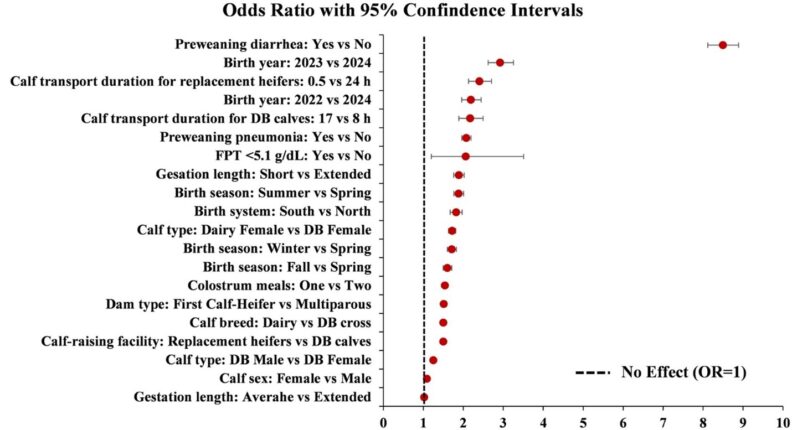
Figure 2: Adjusted odds ratios (OR) and 95% confidence intervals for pre-weaned calf mortality. Calf diarrhea or pneumonia (No as reference), calf birth year (2024 as reference), calf transport duration for replacement heifers (24 h as reference), calf transport duration for BD calves (8 h as reference); calf-raising facility (DB calves as reference), FPT (<5.1 g/dL as reference), colostrum feeding (Two as reference), birth season (Spring as reference), gestation length (Extended as reference), calf type (DB female as reference), calf sex (Male as reference), calf breed (DB cross as reference) and parity (Multiparous as reference).
Table 1: Results of calf mortality up to weaning at the calf facility after transportation (n = 392,064 calves with 9,760 mortalities)
| Calf transport duration | Calves (n) | Mortality (%) | OR | 95% C | P-value | |
|---|---|---|---|---|---|---|
| 0.5 h | 122,407 | 3.56 | 3.6 | 3.12-4.13 | <0.0001 | |
| 8 h | 20,485 | 1.01 | Reference | |||
| 17 h | 212,055 | 2.18 | 2.17 | 1.88-2.49 | <0.0001 | |
| 24 h | 37,117 | 1.55 | 1.53 | 1.31-1.80 | <0.0001 |
Well, as I mentioned above the transportation distances were related to location of birth. The observed increase in mortality in calves born in the south system was likely explained, at least in part, by the summer effect because pregnant dams in the south system were more likely exposed to an extended heat stress period during summer leading to increased preweaned calf mortality (1Monteiro et al., 2016); (2Davidson et al., 2021) compared to those calves born from dams in the north system. Heat stress has a detrimental effect on placental development and function (3Huber et al., 2020; 4Cattaneo et al., 2022); thus, negatively impacting fetal development and programming. For instance, in utero heat stressed newborn calves have reduced birth weight (Collier et al., 1982), increased FPT (5Tao et al., 2012), and subsequent reduced calf growth (Cattaneo et al., 2022) and performance through first lactation (Monteiro et al., 2016).
- In utero heat stress decreases calf survival and performance through the first lactation; Monteiro et al., 2016
- Effect of late-gestation heat stress in nulliparous heifers on postnatal growth, passive transfer of immunoglobulin G, and thermoregulation of their calves; Davidson et al., 2021
- Fetal programming in dairy cows: Effect of heat stress on progeny fertility and associations with the hypothalamic-pituitary-adrenal axis functions; Huber et al., 2020
- Programming effects of late gestation heat stress in dairy cattle; Cattaneo et al., 2022
- Effect of late-gestation maternal heat stress on growth and immune function of dairy calves; Tao et al., 2012
In summary, the various models incorporated in this study attempted to account for confounding between transport duration, calf characteristics, calf-raising facilities, colostrum meals, etc. Taken together, these models highlighted the complexity of calf transport, management, and environmental and biological factors influencing calf survival. Given that calf survival was one of the primary outcomes of this study, it is important to point out that calves fed two colostrum meals were ∼50% less likely to develop diarrhea and ∼54% less likely to die before weaning compared to those fed one meal.
My takeaways from this study were less about transport distances than management. The overall low mortality observed in this study may be attributed, at least in part, to factors such as prepartum nutrition of the dams, herd management (e.g., newborn care, timely colostrum intake), transport fitness (e.g., logistics), and proper loading and unloading practices. Prepartum nutrition and sound overall management likely supported optimal fetal development and adequate colostrum intake, all of which contribute to improved early calf survival and development.