Liver abscesses (LA) continue to represent a major challenge in beef production systems, with significant economic and welfare implications. Recent findings have improved our understanding of the biological, nutritional, and microbial factors associated with LA, as well as their impacts on carcass quality and feedlot performance.
Liver abscesses are polymicrobial in nature and arise from complex interactions among ruminal microbiota, epithelial integrity, and host immune defenses. A recent study by Abbasi et al. (20251) reported similarities between the ruminal epithelial and liver microbiomes of animals with and without abscesses. These findings suggest that a continuous bacterial flow from the gastrointestinal tract to the liver occurs under normal conditions, but that abscesses may form when bacterial translocation surpasses hepatic defense capacity. This supports the hypothesis that LA results not from a single pathogen, but from disrupted microbial balance and compromised host responses. Geographic differences in LA prevalence highlight the influence of regional management systems and microbial ecosystems. Herrick et al. (20222) reported that fed-beef processors in the Pacific Northwest, Central Plains, and Southwest Desert exhibit the highest LA incidences, ranging from 24% to 33%. Moreover, feedlots finishing Holstein cattle show greater prevalence (25%) than those feeding beef breeds (19%). Interestingly, microbial profiles also differ regionally. For example, Trueperella pyogenes is more frequently detected in the Pacific Northwest, whereas F. necrophorum predominates in the Central and High Plains (Herrick et al., 20223). Such findings underscore the need for region-specific interventions that consider both host and environmental factors.
A range of experimental models has been used to induce LA, highlighting the multifactorial nature of this disease. Among the different approaches summarized by Broadway et al. (20234), manipulation of dietary starch and neutral detergent fiber (NDF) levels has emerged as a common strategy to explore disease dynamics. Interestingly, Childress et al. (20255) demonstrated that feeding high-forage diets combined with high doses of Fusobacterium necrophorum and Salmonella enterica was sufficient to induce LA even in the absence of acidotic conditions in beef-on-dairy crossbred cattle. These findings emphasize that diet composition and microbial exposure interact in complex ways, influencing both disease occurrence and severity.
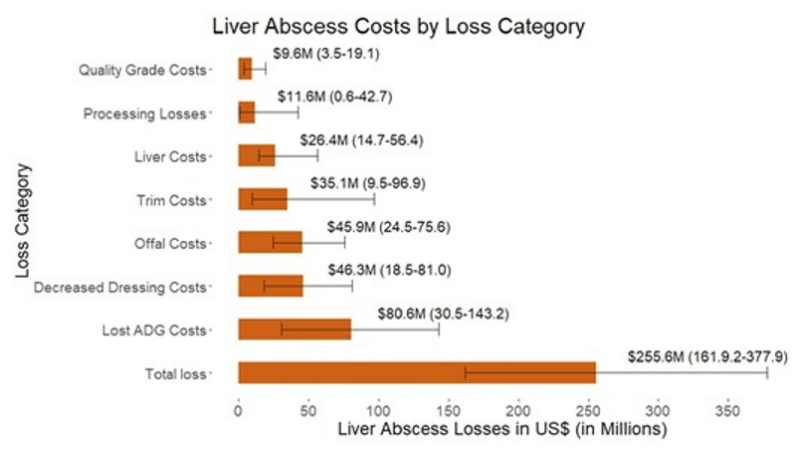
The economic burden of LA is substantial, estimated at up to US$378 million annually to the U.S. beef industry (Figure 1; Taylor et al., 20256). Reduced average daily gain (ADG) and lower dressing percentages account for approximately 49% of these losses. The presence of LA has been shown to negatively affect performance traits, leading to reduced carcass weight and ribeye area (Torres et al., 20247). These effects are largely attributed to reductions in ADG, though dry matter intake (DMI) responses are often variable. This suggests that the decline in carcass yield may not simply be a matter of reduced feed intake, but rather a reflection of how affected animals partition energy toward competing physiological demands, such as immune responses and inflammation (Batista and Holland, 20228). Supporting this idea, Felizari et al. (20259) identified significant differences in hepatic gene expression related to inflammatory and regenerative pathways, which may explain altered energy allocation patterns previously described by Kvidera et al. (201710).
Historically, tylosin phosphate has been widely incorporated into finishing diets to reduce LA incidence. However, increasing public concern regarding antimicrobial use in livestock production is driving efforts to identify alternative management strategies. Modeling scenarios indicate that discontinuing tylosin use could nearly double LA prevalence and associated costs. Collectively, these findings reinforce that LA is a multifactorial condition influenced by diet, microbial ecology, and host physiology. Progress in understanding energy metabolism, immune regulation, and microbial interactions in the liver will be essential to develop effective, antibiotic-free prevention strategies. Future research should continue to integrate nutritional, genomic, and microbial approaches to improve both animal welfare and economic sustainability across beef and beef-on-dairy systems.
Citations
- 1 47 Liver abscess pathogens in healthy livers, normal tissues of abscessed livers and ruminal epithelial tissues of beef-on dairy feedlot cattle
- 2 Exploratory observational quantification of liver abscess incidence, specific to region and cattle type, and their associations to viscera value and bacterial flora
- 3 Exploratory observational quantification of liver abscess incidence, specific to region and cattle type, and their associations to viscera value and bacterial flora
- 4 Liver abscesses—New perspectives on a historic fed-cattle issue
- 5 Evaluating the effects of acidosis and bacterial inoculum concentrations on the development of liver abscesses in beef × dairy steers
- 6 Economic costs of liver abscesses in U.S. beef feedlot cattle: a comprehensive economic analysis Link goes to specific spot in the article.
- 7 The Impact of Liver Abscesses on Performance and Carcass Traits in Beef Cattle: A Meta-Analysis Study
- 8 Liver Abnormalities in Cattle: Effect of Liver Abscessation on Growth and Productivity of Cattle
- 9 Hepatic transcriptome profiling unveils candidate genes in cattle with liver abscesses under the influence of beef genetics in dairy cattle
- 10 Glucose requirements of an activated immune system in lactating Holstein cows