By Craig McConnel, Veterinary Medicine Extension, and John Wenz, Field Disease Investigation Unit
By now you have undoubtedly seen much written regarding the New World screwworm (NWS) detections leading to the closure of southern ports of entry to livestock entries. By the time this article is out there will likely be new developments but at the time of this writing NWS was detected 160 miles north of the sterile fly dispersal locations in Veracruz, Mexico–only 370 miles from the U.S. border. The economic impact of NWS making its way into the US would be significant, as evidenced by the fact that an isolated outbreak of NWS that occurred in Texas in 1976 was estimated to result in $330 million in losses. A recent ERS study (pdf) evaluated what it might look like if NWS reaches Texas now. According to the study, after adjusting for inflation, market conditions, etc., the economic impact could be around $1.9 billion. This study did not account for the record setting beef prices in 2025 along with some other market changes which means the impact could be even larger.
The implications of a NWS infestation are severe, and it made me wonder about the history and biology of this insect. The NWS is named Cochliomyia hominivorax and it is the only primary screwworm in the Cochliomyia genus causing myiasis (parasitic infection of fly larva (maggots) in living tissue). NWS falls within the Calliphoridae family which includes another obligate parasitic species Chrysomya bezziana (Old World screwworm; OWS). Whereas the NWS is primarily endemic to areas of South America (Venezuela, Colombia, Ecuador, Brazil, Paraguay, and Uruguay) and the Caribbean Islands (Cuba, Dominican Republic, Jamaica, and Trinidad, and Tobago), Old World screwworm is endemic to areas of Africa and Southeast Asia. Despite being in different genera and geographically separated, the two species have evolved in remarkable parallel. They have almost identical life histories because they fill identical parasitic niches in their respective geographical zones.
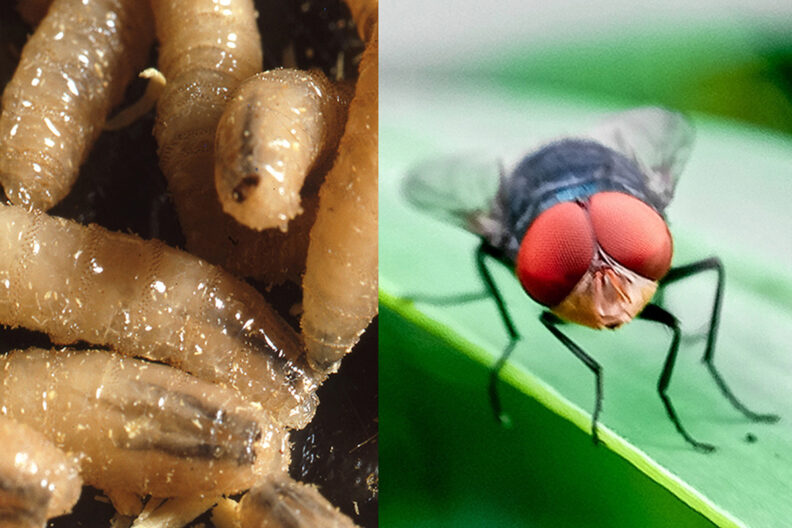
Details related to screwworm biology, behavior, prevention and treatment have been detailed by the WOAH. Unlike most other species of blowflies, adult female screwworms do not lay their eggs on carrion. Instead, they lay them at the edges of wounds on living, injured mammals or at their body orifices. Virtually any wound is attractive, whether natural (from fighting, predators, thorns, disease, and/or tick and insect bites) or man-made (from shearing, branding, castrating, de-horning, docking, and/or ear-tagging). Commonly infested natural wounds are the navels of newborn animals, and the vulval and perineal regions of their mothers, especially if traumatized. If eggs are deposited on mucous membranes, the larvae can invade undamaged natural body openings such as the nostrils and associated sinuses, the eye orbits, mouth, ears, and genitalia. Within 12–24 hours of the eggs being laid, larvae emerge and immediately begin to feed on the wound fluids and underlying tissues, burrowing gregariously head-downwards into the wound in a characteristic screwworm fashion. As they feed, tearing the tissue with their hook-like mouthparts, the wound is enlarged and deepened, resulting in extensive tissue destruction. Infested wounds often emit a characteristic odor, which can be the first indication that at least one animal in a group is infested. Although the odor is not always apparent to humans, it is obviously highly attractive to gravid females, which lay further batches of eggs, so increasing the extent of the infestation. A severe infestation that is left untreated may result in the death of the host.
Though NWS have been present in the southwestern United States since at least 1842, the pest was first documented as a significant problem in the Southeast in 1933, following shipments of infested animals from the Southwest. In response to the rapidly expanding NWS affected areas, the U.S. Department of Agriculture (USDA) and southeastern States engaged in the Screwworm Educational Program in 1935 to instruct producers on how to prevent livestock infestations. The archival Screwworm Eradication Collection and Screwworm Eradication Records with the USDA’s National Agricultural Library are intriguing to peruse and include some interesting and informative videos such as the silent Screwworms—How to Fight Them and Screw Worms, and the somewhat more recent Look Out for Screwworms, Fight Against Screwworm, and others. A particularly gory video is The Screwworm, Excerpt 1!
There are no vaccines or biological products available for managing NWS, except for the use of sterilized male flies in the sterile insect technique (SIT). USDA scientists developed this technique to mass-produce NWS to prevent reproduction. Male flies are sterilized in their late pupal stage by gamma or x-ray irradiation and are sequentially released into the wild in vast numbers. All of their matings with wild females result in infertile eggs only, leading to a progressive population reduction and, eventually, eradication. In operational situations, SIT is supported by the insecticide treatment of screwworm-infested wounds in livestock, by strict control of livestock movement, by the quarantining of infested animals and by an active publicity campaign. SIT is very expensive because of the cost of continuous production and aerial dispersion of sterile flies. Historically, it has been considered cost effective only when used as an eradication strategy in situations where geography would favor such a program.
Clearly the threat of NWS is not going away any time soon. To keep abreast of the situation and for additional resources, please refer to the USDA APHIS New World Screwworm site.