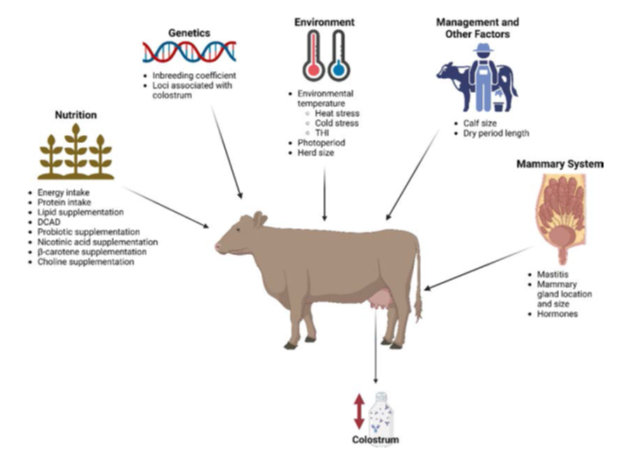
An Invited Review came out in December in Applied Animal Science (Vol. 40, Issue 6, 791-801) that addresses the complexities influencing colostrum production in dairy cows. This is an area that my predecessor, Dr. Moore, and possibly some of you reading this investigated previously (Gavin et al., 2018; Kiser et al., 2019). The takeaways from this latest article suggest that unsurprisingly increasing colostrum yield appears to be tied to nutrition, management, environment, and genetics. The summary of major factors is demonstrated below in Figure 1 taken from the AAS Invited Review.
Specifically, feeding a prefresh diet containing more sugar appears to increase colostrum yield, and feeding diets that meet the prefresh nutrient requirements for dairy cows is essential. Moreover, in a recent study it was shown that moderate hyperketonemia (10%–15%) was associated with increased colostrum yield (Westhoff et al., 2023a). Interestingly, it appears that colostrum yield is generally unaffected by protein intake which suggests that reduced colostrum yield is likely due to energy restriction (Hare et al., 2023). Regardless, Westhoff et al. (2023a) recommended that the CP content of the diet fed to prefresh dry cows should be 13.6% to 15.5% to increase colostrum yield. Furthermore, data suggest that there is a mechanism for enhanced IgG uptake in calves fed colostrum from dams fed more crude protein. This response could be due to a colostrum component that may be involved in intestinal development or prepartum fetal programming. Furthermore, rumen-protected choline has been shown to increase colostrum yield possibly through methionine synthesis.
Increasing dry period length likely increases colostrum yield too; however, that appears to be dependent on the time of year. This is because colostrum yield is slightly less when the dry period length is increased but cows spend the dry period at temperatures below 5°C. Colostrum yield is increased when cows are either between 5°C and 23°C or above 23°C. It has been suggested that perhaps the reason cows produce less colostrum during the cold is due to a reduction of prolactin in the blood to trigger lactogenesis. It is important to note that photoperiod may be confounded with environmental temperature with the highest temperatures generally coinciding with the longest daylight periods. Stahl et al. (2024) found that hours of light per day were not a significant factor affecting colostrum yield in Jersey cows from across the United States. Data were similar in another Westhoff et al. (2023b) study, where varying the lux showed little variation in colostrum yield in Holstein cows. These results suggest that photoperiod may not be the primary reason cows produce more or less colostrum. They also suggest that more research is needed if we are to understand why some cows fail to produce any colostrum at all.