By Dr. Caio Figueiredo, Veterinary Medicine Extension
Metritis is a uterine disease that poses a major threat to sustainability in dairy operations, as the disease is associated with up to US$ 1.2 billion/year in economic losses to the U.S. dairy industry. Recent economic analysis estimated that each case of metritis costs on average US$510.00 (Pérez-Báez et al., 2021), and approximately 20% of the costs associated with metritis arise from antibiotic treatment. Thus, a very common question asked in meetings is: “What if we don’t treat cows with antibiotics and save the money?” In fact, this practice has been adopted across the country, as per the latest USDA report (USDA, 2014), only 52.8% of cows with metritis receive antibiotic treatment (organic dairies excluded). A recent economic analysis aimed to compare the gross profit from cows with metritis treated with ceftiofur and non-treated cows with metritis (Silva et al., 2021). That study reported that non-treated cows with metritis had an average US$250.00 reduction in gross profit compared with cows with metritis that were treated with ceftiofur. Therefore, not treating cows with metritis results in greater economic loss rather than savings.
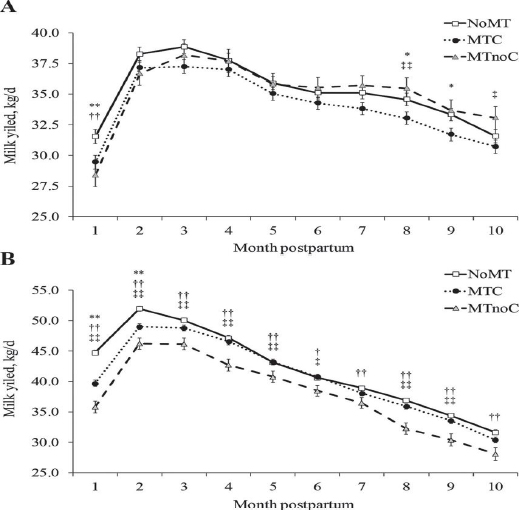
A component that potentially drives the greater loss in profits associated with lack of antibiotic treatment is achievement of clinical cure in a timely manner. Studies have shown that when treated with antibiotics, approximately 75% of cows with metritis achieve clinical cure within 2 weeks after diagnosis (Chenault et al., 2004, McLaughlin et al., 2012, de Oliveira et al., 2020). In contrast, only 57% of non-treated cows with metritis achieve clinical cure in the same time period. A recent study evaluated the clinical implications associated with cure failure of metritis (Figueiredo et al., 2021). In that study, a greater proportion of cows that failed to cure within 2 weeks had subsequent uterine diseases compared with cows that cured (90% vs. 73%, respectively). Moreover, a greater proportion of cows that failed to cure were anovular by 67 days in milk (DIM) compared with cured cows (38% vs. 29%, respectively). Cure failure was associated with an additional 29 days to establish pregnancy compared with cured cows (163 d vs. 134 d, respectively). Lastly, cows with clinical cure failure had reduced milk production which was more severely reduced in multiparous cows (Figure 1), and increased mortality within 10 months of lactation (Cure failure = 26.3%, Cured = 17.4%). Multiple research groups are currently working to elucidate cure patterns in cows with metritis to identify risk factors and develop selective therapy strategies. A few factors, such as calving season (particularly summer), occurrence of retained fetal membranes, pyrexia at the time of metritis diagnosis (rectal temperature ≥103.1°F), and occurrence of metritis ≤5 DIM have been associated with greater likelihood of cure failure.
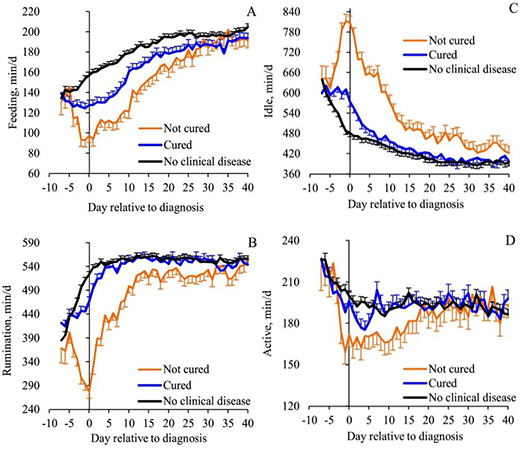
The advancement and implementation of precision technology in dairy herds has allowed researchers to dive deeper into the physiology of metritis and cure. For instance, studies have depicted changes in cow behavior associated with metritis and cure even before its occurrence (Figure 2); Merenda et al., 2021, Prim et al., 2022). Current data does not support the use of selective therapy strategies in dairy cows with metritis, indicating that cows with metritis should be treated with antibiotics to alleviate subsequent detrimental impacts. However, the use of selective strategies for the treatment of metritis in dairy cows is a primary goal for some uterine health and reproductive physiology researchers, and recent data has shown promising results. Research is warranted to elucidate more about metritis and cure in order to develop optimized protocols and to find practical ways to implement them in dairy herds.
References
- Chenault, J. R., J. F. McAllister, S. T. Chester, K. J. Dame, F. M. Kausche, and E. J. Robb. 2004. Efficacy of ceftiofur hydrochloride sterile suspension administered parenterally for the treatment of acute postpartum metritis in dairy cows. J. Am. Vet. Med. Assoc. 224:1634-1639.
- de Oliveira, E. B., F. Cunha, R. Daetz, C. C. Figueiredo, R. C. Chebel, J. E. Santos, C. A. Risco, K. C. Jeong, V. S. Machado, and K. N. Galvão. 2020. Using chitosan microparticles to treat metritis in lactating dairy cows. J. Dairy Sci. 103:7377-7391.
- Figueiredo, C. C., V. R. Merenda, E. B. de Oliveira, F. S. Lima, R. C. Chebel, K. N. Galvão, J. E. P. Santos, and R. S. Bisinotto. 2021. Failure of clinical cure in dairy cows treated for metritis is associated with reduced productive and reproductive performance. J. Dairy Sci. 104:7056-7070.
- McLaughlin, C. L., E. Stanisiewski, M. J. Lucas, C. P. Cornell, J. Watkins, L. Bryson, J. K. Tena, J. Hallberg, and J. R. Chenault. 2012. Evaluation of two doses of ceftiofur crystalline free acid sterile suspension for treatment of metritis in lactating dairy cows. J. Dairy Sci. 95:4363-4371.
- Pérez-Báez, J., T. V. Silva, C. A. Risco, R. C. Chebel, F. Cunha, A. De Vries, J. E. P. Santos, F. S. Lima, P. Pinedo, G. M. Schuenemann, R. C. Bicalho, R. O. Gilbert, S. Rodrigez-Zas, C. M. Seabury, G. Rosa, W. W. Thatcher, and K. N. Galvão. 2021. The economic cost of metritis in dairy herds. J. Dairy Sci. 104:3158-3168.
- Prim, J. G., E. B. de Oliveira, A. Veronese, R. C. Chebel, and K. N. Galvão. 2022. Behavioral changes of metritic primiparous cows treated with chitosan microparticles or ceftiofur. JDS Commun. 3:265-269.
- Merenda, V. R., J. Ruiz-Munoz, A. Zare, and R. C. Chebel. 2021. Predictive models to identify Holstein cows at risk of metritis and clinical cure and reproductive/productive failure following antimicrobial treatment. Prev. Vet. Med. 194:105431.
- Silva, T. V., E. B. de Oliveira, J. Pérez-Báez, C. A. Risco, R. C. Chebel, F. Cunha, R. Daetz, J. E. P. Santos, F. S. Lima, K. C. Jeong, and K. N. Galvão. 2021. Economic comparison between ceftiofur-treated and nontreated dairy cows with metritis. J. Dairy Sci. 104:8918-8930.
- USDA. 2014. Health and Management Practices on U.S. Dairy Operations, 2014. Dairy 2014. USDA-APHIS-VS.